
The Reason We Live
July 23, 2026
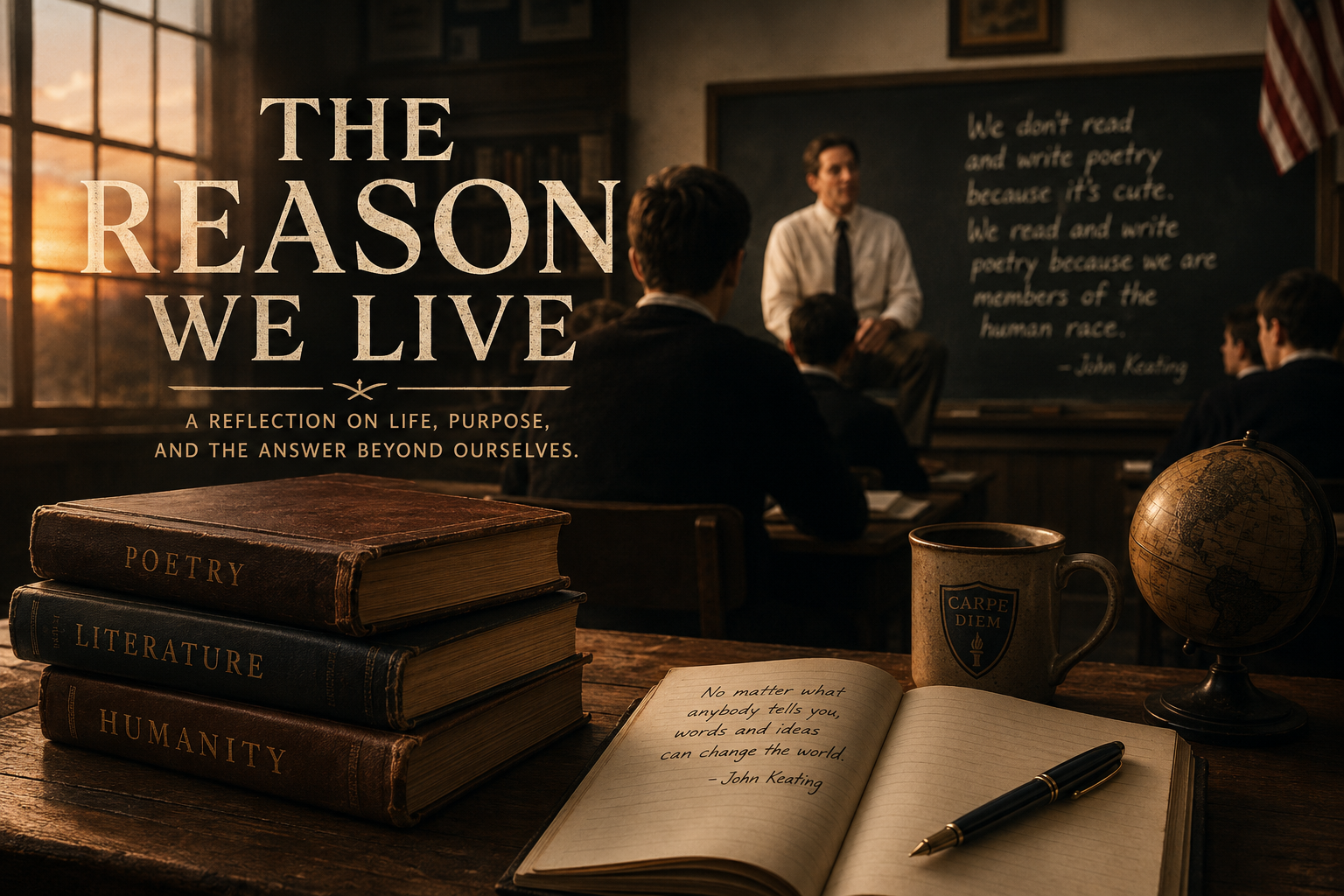
Late at night, lying in bed could be a scary time for me. It was the time when my mind would wander and question the assumptions I lived by. Not just the simple assumptions, but the profound ones. Often during high school and college, I would ponder the fact that we exist at all. I would question the existence of God and what life would mean if He did not exist.
These thoughts would inevitably lead to certain questions: Why do I exist? What am I supposed to do, if anything at all? Is there a best way to live?
The one that Mr. Keating attempts to answer profoundly impacts us, no matter our state in life:
What makes life worth living?
More Than a Career
We rejoin Mr. Keating in his classroom as he declares that words and ideas can change the world. He notices a student reacting to this statement with a facial expression. Keating states what many are thinking: poetry and literature have nothing to do with acceptance into business or medical school. He acknowledges this rebuttal and calls the boys toward him so he can share a secret of life.
As the boys approach him, we have some time to reflect on our own lives. Many of us went to school and then college or a trade school to get an education. This education led to a job. That job allowed us to acquire material possessions and support a family. I would venture to guess that many of us simply did the next thing because we were told to do it. We didn't take time to reflect onwhywe took the next step; we simply did it.
Mr. Keating invites us to reflect.
What We Live For
Keating holds the silence, looking at the boys as they settle in. He then states that poetry is written and read not because it is cute, but because we are members of the human race. Law, medicine, and engineering are all noble pursuits, needed to sustain life. However, those are not what we live for.
Keating then offers beauty, romance, and love as reasons worth living.
Some may scoff at Keating, just as his own students did, and his claims about professions like law, medicine, and engineering. However, each of these jobs points to something greater than itself. Law creates a just society for all people. Medicine revives people so they can continue to live. Engineering creates the tools, buildings, and roads that we live in and utilize. Though they look very different, each profession ultimately exists to serve people.
Each of these has humanity at its core. They are noble when they work to improve humanity.
The arts, especially the poetry that Keating is teaching, are the same way. They are meant to capture our humanity, enchanting us with romance and conveying the beauty found in the world. The arts are noble when they inspire humanity.
A Deeper Question
Keating offers us most of the answer, but he still doesn't quite answer my original question. He is circling an answer that many of us know in our souls.
All the careers listed above point to people being the answer. I can acknowledge that many of the trials I face and the sacrifices I offer are for my family and community. We see soldiers willing to sacrifice their lives for their fellow soldiers and their loved ones back home. We see fathers wake up before sunrise to work jobs they dislike to support the family they love. We see mothers sacrifice their bodies to bring babies into the world.
Human life is immensely valuable, and many people would be justified in saying that human life is the reason for living.
However, we still have to ask why human life is so valuable if we want to get closer to answering why we live.
On the surface, this seems like a no-brainer. Human life appears to have inherent value because it is a self-evident truth. However, reflecting on history, we see that many cultures have not held the same view.
Human value is often taken for granted because we are bathed in a Christian or post-Christian worldview.
We instinctively believe every person deserves dignity. We believe every life matters. We believe the weak should be protected and the vulnerable cared for. These convictions feel obvious to us.
This view flows from the Christian teaching that every person is created in the image and likeness of God. Since we are all created in His image, every human person possesses immense dignity and value.
All of this gets us close to the answer, but as we see, human dignity points to something greater—to God.
Looking to God, and to who He truly is, we will finally receive an answer to our question. Thankfully, Mr. Keating has more to offer our reflection next week.
Weekly Challenge
Set aside ten quiet minutes this week and reflect on one question:
Why do I believe every human life has value?
Don't settle for your first answer. Keep asking "why" until you can't go any deeper.
You may be surprised where the question leads.
Forge Ahead
Anvil: the place of formation.
Arrow: the mission we're sent on.
The world needs more men formed in virtue. Forward this to a brother who's ready to grow.
Know someone who would benefit from this letter?
Send it to a friend, brother, or fellow traveler who may need it today.
Continue with a related letter
Follow a shared story, continue a related lesson, or take a different road.
The Whisper
Mr. Keating's whispered call to seize the day confronts our passivity and asks what deserves the limited time we have been given.
Why We Desire Glory
Our desire for glory is ultimately a desire to be known and welcomed by God—not merely praised by an unstable world.